Showing posts with label Fényképek. Show all posts
Showing posts with label Fényképek. Show all posts
Sunday, April 11, 2010
Mi lesz?
It is 2 am, and the polls were supposed to close seven hours ago. The OVB (Orszagos Valasztasi Bizottsag) 'decided' to keep 'certain' polling stations 'open' past the closing time. However, it hasn't exactly been made clear which ones, nor has it been announced exactly why. Someone mumbled something about staying open for 'those voting outside of their normal polling places.' Something is rotten in the state of...

Saturday, April 10, 2010

Saturday, February 20, 2010

Wednesday, February 10, 2010
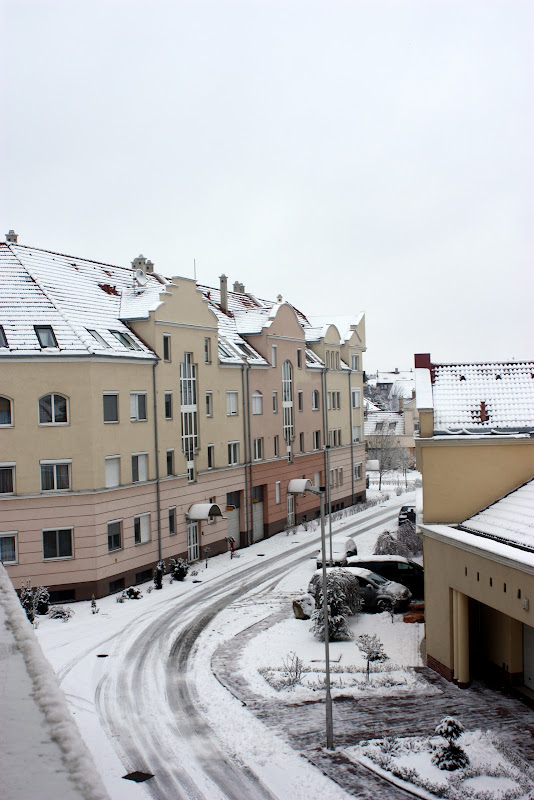
Yet another advantage of living out here in Debrecen is the real estate prices. I have an American style two-bedroom apartment (actually, it is owned by a Hungo-American couple) in a brand new development, replacing a decrepid old mill, near the center of town. Of course, in the middle of developing the street, they ran out of money in the great economic "krizis" of 2008, which hit Hungary especially hard. So, next to my building is the ruins of a mill. If I wanted to stay in Hungary past June 1st, when my Fulbright grant runs out, I would try and open a "romkert" - a ruins beergarten, like the ones in Budapest. It is the one thing Debrecen lacks!

Although I wish I was having the 'genuine' experience of living in a pánellákas flat or the 'authentic' experience of living in a fin-de-siécle Hapsburg building apartment, my living conditions are quite, ahem, comfortable. Far more comfortable than anything I will be able to afford in the States in the next twenty years. If I were in Budapest, the same rent would get me a cubby with no hot water. I actually have a shower here! And functioning heat that I can control from within my own apartment. In Hungary, thermostat is worth its weight in gold - most communist-built cement panel houses have central heat controlled by the building master. He often turns up the heat past 80 deg F, as with bigger heat bills comes a bigger profit.Added to the fact that the Russian Gazprom controls all gas and gas prices, and it turns out most families pay more than their rent each month in gas heating. Shelter may not be expensive, but warm air is!

Tuesday, February 9, 2010

Monday, February 8, 2010
Nagypiac

I love the fact that I live five minutes away from the biggest fresh market in town. It runs every morning, and I see fruits and vegetables I cannot even name in English, let alone Hungarian. I now have the reverse problem: there are several fruits and vegetables I can name in Hungarian, but not English. I buy milk that was taken from the cow that morning, and I have to boil it before I can drink it (mmm pasteurization). The colors of all the produce are amazing... and it is all grown locally, as there isn't enough money to import anything (the one exception: oranges at Christmas time are a very important tradition, and I just bought some of the first batch this morning). I love going there, as the old women who man the stalls call out to me, "Drágám! Szivem! Tessék!" (My dear, my sweet, how can I help you?). There are a few produce consolidators, but most vendors are the widowed grandmothers of the farmers, dressed in all black with headscarves. They get dropped off at 5:30 am from the village and sell until 1 pm, when their sons and grandsons come back to pick them up and whatever produce wasn't sold. I've made lots of fun things (lots of Hungarian recipes too): this morning I made a meringue pavlova from fresh egg whites, butternut squash ravioli by hand (including making and rolling my own pasta from scratch!) in a browned butter sauce, quince tarte tatin, tons of roast vegetables with garlic,...the list goes on.

Sunday, February 7, 2010

Friday, February 5, 2010
Thursday, February 4, 2010

Wednesday, February 3, 2010
Nádudvar

In an effort to procure some meaningful birthday presents (and maybe a sacrifice to the pagan ikon Valentin), I took a short field trip this afternoon to Nádudvar, a small village about an hour outside of Debrecen. When I got on the bus, it was cold and cloudy, just as the weather report the night before had indicated. When I got off the bus in Nádudvar, I found myself in the middle of a blizzard.

Nádudvar is famous for its black pottery. Though the shape and patterns might otherwise resemble the prototypical Hungarian pottery, in lieu of a white background glaze and colorful painted flowers, the pottery is black. In fact, so black, it resembles lead. Folk-art flowers are drawn into the black glaze with the aid of several types of pumice stones that create a matte, shiny, or textured finish.

After walking two kilometers through the blizzard from the bus stop, I finally arrived at 152 Fő utca. Err, what was supposed to be 152 Fő utca (152 Main Street). In actuallity, it was 152 Vörös Hadsereg utca: 152 Red Army Street. Perhaps the street name has been changed on the map, but it looks like someone forgot to change the street signs and address tiles. Ajaj!

With two inches of fresh snow on the ground, 152 Red Army Street looked just like every other house on Red Army Street (surprised much?). But instead of curly-haired Mangalica pigs inhabiting the old adobe shed's thatched roof, the windows revealed tables and table of pottery. The shed was empty and locked, so I crunched through the snow over to the main house's steps to ring the bell. A middle-aged man answered the door, and I stammered out as fast as possible, “HelloSir,IamsorrytobotheryoubutIamlookingforsomeblackpotteryDoyouknowhereIcanfindsome?”. He took one look at me, the frizzy-haired American covered in a centimeter of snow (I had been walking for over thirty minutes!) wearing bright blue rubber boots and ringing his doorbell in the middle of a blizzard, and said “ I will be right out, just let me grab my coat.”

We walked over to his shed/studio, where he proceeded to give me a twenty minute tour of his operations. He showed me the pottery his direct ancestors had made in 1772 – they have passed down the craft since the beginning of the eighteenth century. He showed me his family tree, and gave me the lowdown on each of his family members and their skills. He showed me the whole in the ground where he stores the wet clay before use. He showed me his kiln, essentially a closed adobe beehive fireplace. Only then did he ask what type of products I was looking for. But instead of showing me something he already had in stock, he started writing notes. Then he asked me to write down the name of the person it was for, and what designs I was looking for. At first I didn't understand – was my Hungarian that bad? Could he not understand me, so was resorting to hieroglyphics? I had no idea that my trip to buy some pottery would require a second trip to Nádudvar: he wanted to make the pieces specifically for me, so they were exactly what I wanted. When I asked how much it would cost, I almost felt guilty accepting such personalized work for such a low price. But then he asked me to drink some of his házipálinka (homemade fruit brandy fire water) with him to celebrate the deal...so I quickly forgot any such guilt whatsoever. A burning throat and a buzzing head is rather distracting.

Tuesday, February 2, 2010
The Székely Gate to Heaven

According to the EU, the UN, and the Treaty of Trianon, Debrecen sits less than thirty kilometres from the Hungarian-Romanian border. According to most Hungarians, Romania doesn't start for at least another 800 kilometres. The region in question, Transylvania, has been disputed for several hundred years. I do not dare dip my toe into the pool of Hungarian revisionism, so to sum up, Transylvania has a mixed population of Hungarians, Romanians, Saxon Germans, and Roma. The proportions of each population ebb and flow as time marches on. Today, the Romanians are numerically the majority.
Believe whatever you want to believe about Transylvania: the culture of the region remains inherently unique. One facet of the region's folk architecture is the Székely Kapu, or the Székely Gate. The Székely are a group believed to have been sent to the outer eastern reaches of the Transylvanian Carpathian mountains to guard the border. According to Hungarians, they were guarding the border of Hungary. However, until the Ausgleich of 1867, Transylvania was a separate principality - a separate entity from the rest of Hungary. Hungarians also like to claim the Székely as 'true Hungarians,' it the more likely version of events is that they were a Turkic tribe 'Magyarized' in the Middle Ages. I do not profess to be a Historian, so I will end my explanation here.

No matter where they came from or what their blood line is, the Székely gates are a beautiful example of folk architecture. In 1920, after the Treaty of Trianon ceded Transylvania to Romania, many Hungarians left the region as refugees. For many, the destination of choice was Debrecen: a market town near to the new border. In addition, several faculties of the university in Kolozsvár, now Cluj-Napoca, were transferred into the university at Debrecen. As refugees, they brought only their most important possessions - often-times including their gates. Hence, Debrecen has quite a few of these old gates built into 1920s-era homes. I walk past two daily: the one pictured is a block over, and a second is right below my living room window. Unfortunately, the second gate's ancient cultural origins are somewhat occluded by modern Hungarian cultural norms: affixed to the Székely Kapu below my window is a neon sign for the "Erotika Barlang" - "Erotic Cave."
Monday, February 1, 2010
Szabolcsi Snow
I had a busy day up in Tiszavasvári today. Though it was an early morning in the snow (almost two feet of it in Szabolcs Megye), the day was actually quite sunny and nice. The train up there was even almost on-time! What a concept!

Baba the horse, of Tiszavasvári
I walked around a bit before my meeting began, and I was surprised to see how little had changed. Sure, the old library was closed and a new town hall expansion was added, but otherwise, the town looked exactly the same. Some stores even had the same window decorations still up from five years ago.

Baba asking, "Does this wagon make my butt look big?"
Nonetheless, time goes on, and some things indubitably will change. The schools I worked in have now been centralized under one principal, a great guy who was the gym teacher when I worked there. Part of one school has been contracted out to a private foundation. Let's hope it is for the best. I was floored - FLOORED - by how many people recognized me. Everywhere I went, people were doing double takes and then exclaiming, "Baaarrrbbaaarraaaaa! [nearly wailed] Is it really you? Can it be?" I took the train back from Tiszavasvári to Debrecen with Zita-néni, a teacher who I sort of remembered (she used to take me out for ice cream), but who DEFINITELY remembered me. We chatted in Hungarian the whole ride back, and she even called her daughter to tell her who she had seen, and made me talk on the phone with her (I have never met her daughter before, though she is my age). Zita also offered me some of her házipálinka to take home to my boyfriend. I miss Tiszavasvári. There is no comparison for their kindness to me.

Sunday, January 31, 2010
Snowed in

Winter has Debrecen firmly in its grip at the moment. Snow has been in the forecast for the majority of the last four weeks, though the actual impact has ranged widely from a few flurries to 8 inches. Unfortunately, this weekend was the latter. Though snow was forecast from this past Tuesday straight through to next Monday, Tuesday, Wednesday, Friday and today have been cold with flurries but little accumulation. The brunt of the snow hit on Thursday and Saturday. Ordinarily, I would not mind - I love snow! But what was supposed to happen on Saturday morning? A good friend was supposed to fly in from London for a 48 hour tour of Budapest. Spoiler alert: he did not make it.
I set out early Saturday morning for Budapest, intending to meet said friend at Ferihegy Airport. It was cold, but surprisingly sunny. On the train, he called to say, "Um, it looks like the flight is cancelled. For some reason Ferihegy is closed? I will try and get on a flight this afternoon."
I looked out the train window, and it was cloudy, but no snow.
Ten minutes later: "There are no flights this afternoon. No one is going to Budapest today."
Still no snow coming down.
Twenty minutes later: "I am giving up and going back to London."
I got off train at the next stop, Szolnok (ironically only one stop from Ferihegy), and hopped on the next InterCity train back to Budapest. Thankfully, it was the last InterCity train that ran out of Budapest that day - due to the rapidly falling temperatures, the switches froze, preventing the 1960s vintage Soviet trains from leaving. Gas engines were patrolling the tracks, with workers in orange hopping off to uncover the crucial frozen switches. But it still wasn't snowing.
Two and a half hours later, the train pulls into Debrecen. I hop off, and immediately, it started snowing.

Tuesday, August 11, 2009
Arrival in Hungary
I have officially arrived in Budapest, by hook or by crook. I have to say, Continental Airlines did everything in their power to prevent me from getting here (Really? A malfunctioning video system necessitates a three and a half hour delay? Was it really that important to circle London four times before landing? The view of London Tower, Hyde

Park, and Buckingham Palace from 2000 feet was gorgeous but rather superfluous...and in any case, who needs to make a flight connection after all?) but somehow, I persevered long enough to hear those sweet words: “Üdvözöljük Magyarországon!”
I have left the heavy suitcases at a friend's parents' apartment (Thanks ZB!) while I attempt to find an apartment and flit between Vienna, Budapest Orientation, and Debrecen.
Subscribe to:
Posts (Atom)